Some links may earn us a commission at no cost to you. Learn more.
In this guide
Quick answer. The inlet box itself is a small part of the bill. HomeGuide’s national cost guide lists $20 to $100 for the box, but because it must be paired with a transfer switch or interlock, most homeowners pay for a full hookup, which the same guide puts at $400 to $850 with an interlock and $400 to $1,300 with a manual transfer switch. Your wire run, panel and permit rules decide where your quote lands.
A generator inlet box lets you plug a portable generator into the outside of your house with one cord, instead of running extension cords through a window. It is one of the most useful upgrades for anyone who relies on a portable generator in outages. It is also a job where quotes vary widely, which makes it hard to know whether a price is fair.
This guide explains what the job includes, shows the published cost ranges we could find, walks through what pushes a quote up or down and lists the questions to ask before you hire an electrician.
We have not priced this work in your area, and we do not invent cost figures. The ranges below come from the published cost guide and government data we link, so treat them as a starting point and rely on local written quotes.
What an inlet box installation includes
An inlet box is a weatherproof box with a male power inlet, mounted on an outside wall. You connect the generator to it with a cord, and wiring inside the wall carries the power to your panel.
Reliance Controls, a well known maker, publishes the installation instructions for its PB30 inlet box. They show what the job involves.
- The inlet box. The PB30 is a 30 A, 125/250 V inlet with a NEMA L14-30 connection in an outdoor rated NEMA 3R box, according to its retail listing. At 240 V, 30 A works out to about 7,200 W by our arithmetic.
- Wire from the inlet to the panel. Reliance specifies copper wire of AWG #10 minimum and #8 maximum for the 30 A inlet, with a separate ground where required.
- A transfer method. Reliance says that when the inlet powers a structure, it must be used with a transfer switch. A listed panel interlock kit with a dedicated generator breaker is the other common approach.
- A generator cord. A four conductor 30 A cord with the right plug for your generator on one end and an L14-30 connector on the other.
- Placement. Reliance says to locate the inlet away from doors and windows when using an engine driven generator, to avoid carbon monoxide building up.
- A permit and inspection in most areas.
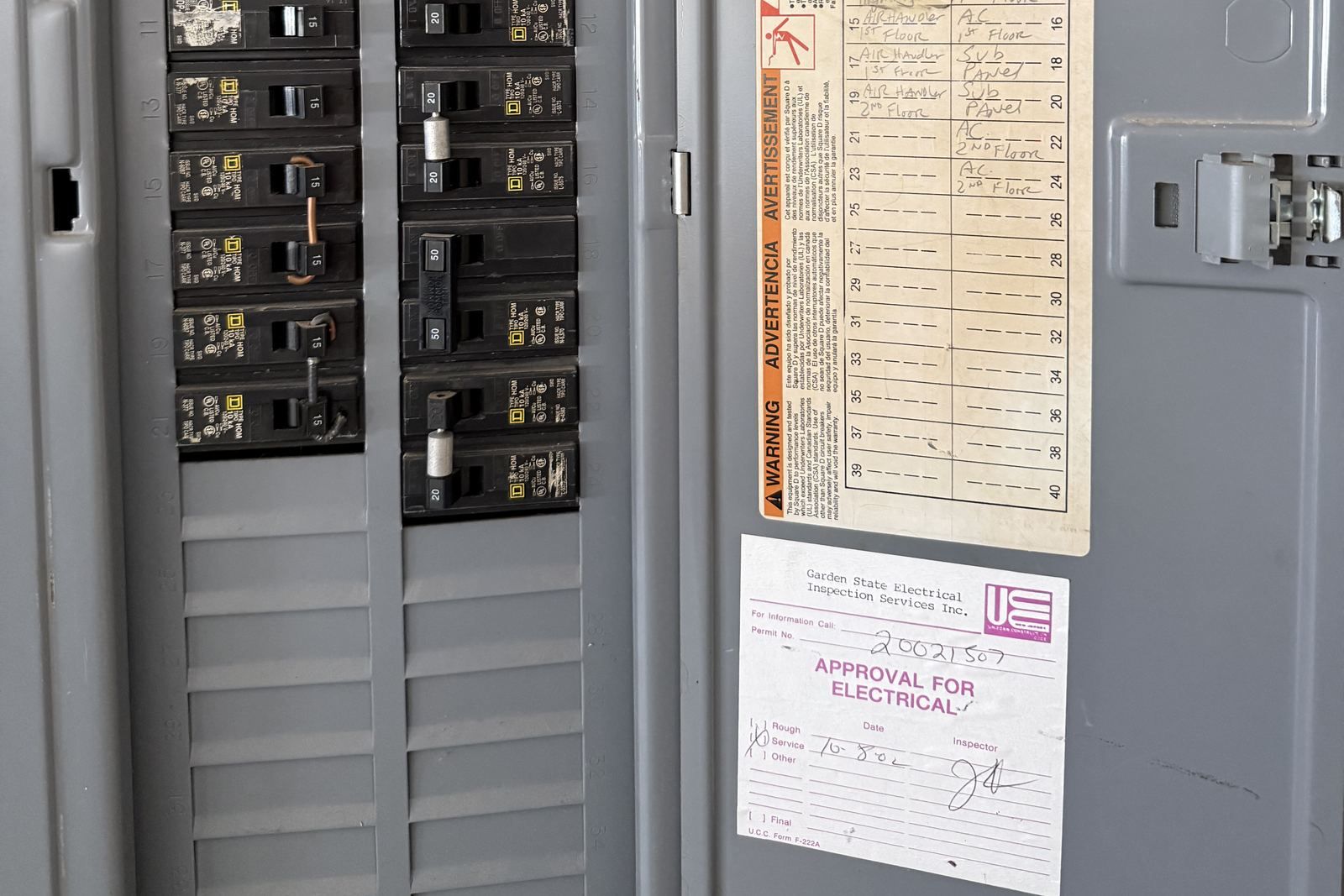
The hero photo above shows an inspected residential panel. The approval sticker on the door is what a finished, permitted job looks like.
Published cost ranges
We found few national sources that break this job into parts. HomeGuide’s transfer switch installation cost guide, checked in November 2026, gives these ranges. They are its estimates, not quotes and not our figures.
| Item | HomeGuide’s range |
|---|---|
| Power inlet box (part) | $20 to $100 |
| Heavy duty generator cord (part) | $30 to $350 |
| Installation labor, straightforward job | $200 to $500 |
| Electrical permit | $50 to $350 |
| Interlock kit installed, including breaker, inlet box and cord | $400 to $850 |
| Manual transfer switch installed | $400 to $1,300 |
| Automatic transfer switch installed | $600 to $2,500 |
HomeGuide also says electricians charge $50 to $130 per hour plus a call out fee, and that a transfer switch job takes 2 to 4 or more hours.
For context on labor, the US Bureau of Labor Statistics Occupational Outlook Handbook lists a median pay for electricians of $30.38 per hour in May 2025. That is what electricians earn, not what a contractor bills. A company’s hourly rate also covers insurance, vehicles, licensing, overheads and travel, which is why quoted rates are higher.
What pushes your quote up or down
The box is cheap. Almost everything else in the price depends on your house.
Distance from the inlet to the panel
The wire run is the biggest variable. An inlet mounted on the outside wall right behind the panel may need only a short length of cable. An inlet on the far side of the house, or one that has to reach a detached garage panel, needs a much longer run and more labor.
Wall and ceiling access
Running cable through an unfinished basement or garage is quick. Fishing it through finished walls and ceilings takes longer and may need patching afterwards.
30 A or 50 A
A 30 A inlet carries about 7,200 W at 240 V, which suits many portable generators. Larger generators with a 50 A outlet need a 50 A inlet, heavier wire, a larger breaker and a heavier cord, all of which cost more.
Interlock or transfer switch
Your transfer method has a bigger effect on the total than the inlet does. An interlock uses your existing panel and a generator breaker. A manual transfer switch adds a separate panel with selected circuits. An automatic switch is usually for standby generators. Read interlock kit vs transfer switch and manual vs automatic transfer switches to decide which suits you.
Panel condition
An interlock needs a listed kit for your panel model and a free space for the generator breaker. If your panel is full, very old or has no listed kit, the electrician may suggest a transfer switch or other work instead. HomeGuide notes that a home may need electrical changes before a transfer switch can be installed if its system is not up to code.
Permits and local rules
Permit fees and inspection rules are set locally. Some areas also require a licensed electrician for this work. Ask whether the quote includes the permit fee and the inspection visit.
What you plug in
A generator that will run a 240 V well pump or a large furnace may need a bigger inlet and cord than one running a fridge and lights. Size the generator first with our generator size calculator, and see what size generator a well pump needs if you have a private well.
Questions to ask before you hire
Ask each electrician to put the answers in writing.
- Is the price itemised? Look for the inlet box, wire, breaker, interlock or transfer switch, cord, permit and inspection listed separately.
- Is the interlock or transfer switch listed for my panel? Ask for the make and model.
- Where will the inlet go, and how far is the wire run? Make sure the location keeps the generator well away from doors and windows.
- What amp rating will you install, and does it match my generator?
- Who pulls the permit and who attends the inspection?
- Is the generator cord included?
- What happens if you find a problem with my panel? Ask how changes to the price would be agreed.
- Are you licensed and insured for this work in my area?
- What warranty covers the work?
Get at least three quotes, compare them line by line, and be cautious of a quote that leaves out the transfer method or the permit.
Can you use the inlet with a power station
Some larger power stations can feed a house through an inlet and transfer switch, as long as they offer the right output and plug. Read how to connect a power station to a house transfer switch before you buy an inlet with that plan in mind, because the amp rating and voltage need to match the station.
Bottom line
A generator inlet box is a small, cheap part, but it is only safe as part of a full hookup with a transfer switch or listed interlock. HomeGuide’s published ranges put that whole job at roughly $400 to $850 with an interlock and $400 to $1,300 with a manual transfer switch. The real cost depends on your wire run, wall access, panel and local permit rules, so get itemised written quotes from licensed electricians and make sure the permit and inspection are included.
This article is general information, not a quote or electrical advice. Use a licensed electrician and follow your local electrical code.
Frequently asked questions
How much does it cost to install a generator inlet box?
HomeGuide's national cost guide lists $20 to $100 for the inlet box itself, $200 to $500 for labor on a straightforward job and $50 to $350 for permits. Because an inlet must be paired with a transfer switch or interlock, most people pay for the whole hookup, which HomeGuide puts at $400 to $850 with an interlock and $400 to $1,300 with a manual transfer switch. Your local quotes are the only reliable figure.
Do I need a transfer switch with a generator inlet box?
Yes, or a listed interlock kit. Reliance Controls says its PB30 power inlet box must be used with a transfer switch when it powers a building. Without a transfer method, a generator can backfeed the grid and endanger utility workers.
Can I install a generator inlet box myself?
Reliance Controls says installation of its inlet box and wiring must be done by a qualified electrician in line with all electrical codes. Most areas also require a permit and inspection for this work, so check your local rules first.
What size inlet box do I need?
Match it to your generator's largest outlet. A 30 A inlet such as the Reliance PB30 uses a NEMA L14-30 connection, which at 240 V carries about 7,200 W. Larger generators with a 50 A outlet need a 50 A inlet, heavier wire and a matching cord.
What makes an inlet box installation cost more?
A long wire run from the inlet to the panel, finished walls, a full or outdated panel, a 50 A setup instead of 30 A and local permit fees all add cost. A transfer switch with more circuits also costs more than a simple interlock.
Thanks! You're on the list. Download your checklist now.