Some links may earn us a commission at no cost to you. Learn more.
In this guide
Quick answer. For a submersible well pump, Franklin Electric lists minimum generator sizes of 2 kW for 1/2 hp, 3 kW for 3/4 hp, 4 kW for 1 hp, 5 kW for 1.5 hp and 7.5 kW for 2 hp on three wire pumps. Two wire pumps need about 50% more, for example 6 kW for 1 hp. Add your other loads on top, and make sure the generator has a 240 V outlet if your pump runs on 240 V.
If your home is on a private well, a power cut also means no running water, no toilet flushing and no way to fill a bath. A generator solves that, but only if it can start the pump. Well pumps are among the hardest household loads to start, and a generator that looks big enough on paper can stall or trip when the motor kicks in.
This guide uses figures from Franklin Electric’s application manual for submersible motors, which installers widely use, to show the minimum generator size by horsepower and wiring type. It also explains why the starting surge matters and how 240 V affects your setup.
We have not tested these pumps or generators ourselves. Every figure below comes from the maker documents we link, and any added figures are our own arithmetic from those sources.
Minimum generator size by pump horsepower
Franklin Electric publishes its AIM manual (application, installation and maintenance) for 60 Hz submersible systems. We read the 2026 edition, which a state agency hosts as a PDF copy. Its generator minimum rating table lists these sizes for single phase pumps.
| Pump motor | Three wire minimum | Two wire minimum |
|---|---|---|
| 1/3 hp | 1.5 kW (1.9 kVA) | 2.25 kW (2.85 kVA) |
| 1/2 hp | 2 kW (2.5 kVA) | 3 kW (3.75 kVA) |
| 3/4 hp | 3 kW (3.8 kVA) | 4.5 kW (5.7 kVA) |
| 1 hp | 4 kW (5.0 kVA) | 6 kW (7.5 kVA) |
| 1.5 hp | 5 kW (6.25 kVA) | 7.5 kW (9.375 kVA) |
| 2 hp | 7.5 kW (9.4 kVA) | Not listed |
These are minimums for the motor on its own. Franklin also notes that a minimum sized generator acts as a soft start for the motor, so you should not combine it with a reduced voltage starter, because both drop the voltage and the combination can damage the motor.
If you also want to run a fridge, lights, a furnace blower or a sump pump, add their running watts to the pump figure. Our generator size calculator adds up running and starting watts for common household loads.
Why starting the pump sets the size
Once it is running, a well pump uses far less power than those minimums suggest. Franklin’s motor specification tables list these full load figures for 4 inch single phase motors at 230 V.
| Motor | Full load watts | Watts at maximum service factor load | Locked rotor amps, two wire | Locked rotor amps, three wire |
|---|---|---|---|---|
| 1/2 hp | 670 W | 960 W | 32.2 A | 23 A |
| 3/4 hp | 940 W | 1,310 W | 40.7 A | 34.2 A |
| 1 hp | 1,210 W | 1,600 W | 48.7 A | 41.8 A |
The locked rotor amps are what the motor draws in the instant it starts, before it spins up. For a 1 hp two wire motor that is 48.7 A, compared with about 8.2 A at full load, roughly six times as much.
A generator has to supply that surge without its voltage collapsing. Franklin says generators must be sized to deliver at least 65% of the motor’s rated nameplate voltage during starting, to give enough starting torque. A generator that is too small sags below that, the motor cannot get going, and either the generator trips or the motor overheats.
That is why the table sizes look large compared with the running watts. You are paying for the start, not the run.
Two wire vs three wire pumps
The two columns in Franklin’s table differ by about half again. The reason is where the starting components live.
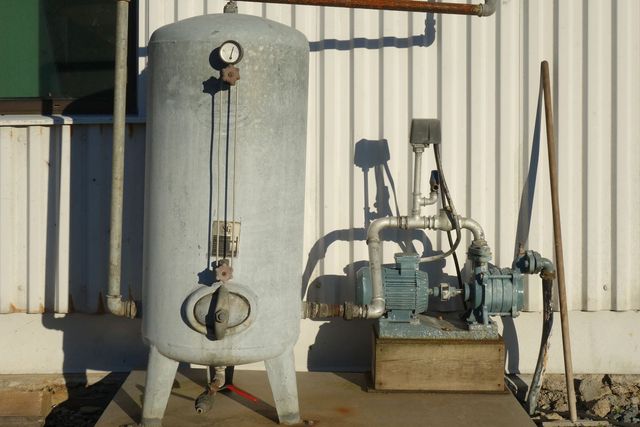
- Three wire pumps have a separate control box above ground, often next to the pressure tank. It holds the start capacitor and relay that help the motor start. Franklin’s manual says single phase three wire motors require a control box, and that the box and motor must match in horsepower and voltage.
- Two wire pumps have no control box. The starting parts are built into the motor at the bottom of the well. They are simpler to install, but in Franklin’s tables they draw more current on starting, so they need a bigger generator.
To check which you have, look near your pressure tank. If there is a small grey box wired between the pressure switch and the well, read its label for the horsepower and voltage. If there is no box, you most likely have a two wire pump, and the horsepower may be on well records or the original installer’s paperwork.
120 V vs 240 V pumps
Franklin’s tables list 1/2 hp motors in both 115 V and 230 V versions, while 3/4 hp and larger motors in the same table are listed at 230 V only. In practice most household submersibles are 240 V.
That matters for your generator choice.
- The generator needs a 240 V outlet. Many portable generators have a 30 A twist lock outlet (NEMA L14-30) or a 50 A outlet (NEMA 14-50) that supplies 240 V. Many small inverter generators supply 120 V only.
- The pump runs on its own breaker. A 240 V well pump is on a double pole breaker in your panel. To power it from a generator, you need a transfer switch or a panel interlock with an inlet box, installed by an electrician.
- Do not backfeed. Franklin’s manual warns that automatic or manual transfer switches must be used any time a generator is used as standby or backup on power lines, to prevent electrocution.
Our guide to interlock kits vs transfer switches explains both options, and generator inlet box installation cost covers what that work involves.
Running a pump on a generator day to day
Franklin’s manual includes a short list of operating rules for generators and submersible pumps.
- Start the generator first. Always start the generator before turning on the pump, and turn the pump off before shutting the generator down.
- Do not let it run out of fuel with the pump on. Franklin warns that the motor’s thrust bearing may be damaged if the generator coasts down with the motor running or runs out of fuel.
- Watch the frequency. Motor speed follows the generator’s frequency. Franklin says a pump running 1 to 2 Hz below its design frequency will not meet its performance curve, and one running 1 to 2 Hz above may trip its overloads.
- Derate for altitude and natural gas. Follow the generator maker’s guidance on reduced output at higher elevations or on natural gas.
It also helps to start the pump with other large loads switched off. Once the pump is running and the pressure tank is full, the pump will cycle off, and you can bring other loads back on.
Worked example
Say you have a 1 hp three wire pump and want to run a fridge, a gas furnace blower and some lights in an outage.
- The pump’s minimum from Franklin’s table is 4 kW.
- Add the running watts of the other loads from their labels or our appliance wattage chart.
- If those come to 1,000 W, a generator rated at least 5 kW running would be a sensible starting point, with a 240 V outlet.
If the same pump were two wire, the pump minimum alone would be 6 kW, so you would look at about 7 kW or more. Our generator size calculator does this sum for you.
What about a battery or power station
A well pump is possible on a large battery system, but the same starting surge applies, and you need 240 V output. Many portable power stations offer only 120 V, and their surge ratings may not cover a two wire pump’s start. For split phase stations, soft starters and which published specs clear a pump start on paper, read battery backup for a 240 V well pump. If you are weighing batteries against a generator for the whole house, also see home battery vs generator costs and expandable power stations for home backup.
Bottom line
Size a generator for a well pump by its start, not its run. Franklin Electric lists minimums of 2 kW for a 1/2 hp, 3 kW for a 3/4 hp, 4 kW for a 1 hp, 5 kW for a 1.5 hp and 7.5 kW for a 2 hp three wire pump, and about 50% more for two wire pumps. Add your other loads, choose a generator with a 240 V outlet if your pump needs it, and have an electrician connect it through a transfer switch or interlock.
This article is general information. Follow your pump and generator manuals and local electrical code, and use a licensed electrician for any connection to your home’s wiring.
Frequently asked questions
What size generator do I need for a 1 hp well pump?
Franklin Electric's AIM manual lists a minimum of 4 kW for a 1 hp three wire submersible motor and 6 kW for a 1 hp two wire motor. Those figures cover the pump alone, so add the running load of anything else on the generator.
Will a 3,500 W generator run a well pump?
It meets Franklin's 3 kW minimum for a 3/4 hp three wire pump and the 2 kW minimum for a 1/2 hp three wire pump, but not the 4.5 kW listed for a 3/4 hp two wire pump. Check the generator has a 240 V outlet if your pump needs it, and keep other loads off while the pump starts.
How do I know if my well pump is 2 wire or 3 wire?
A three wire pump has a separate control box, usually near the pressure tank, which holds the starting components. A two wire pump has no control box because those parts are inside the motor down the well. The control box label normally shows horsepower and voltage.
Can an inverter generator run a well pump?
It can if its continuous rating meets Franklin's minimum for your pump and it has the right voltage outlet. Many smaller inverter generators offer only 120 V, which cannot run a 240 V pump without other equipment.
Why do well pumps need such a big generator?
An induction motor draws several times its running current for a moment while it starts. Franklin says the generator must hold at least 65% of the motor's rated voltage during starting, and a small generator's voltage sags too far under that surge.
Thanks! You're on the list. Download your checklist now.