Some links may earn us a commission at no cost to you. Learn more.
In this guide
Quick answer. Most CPAP users need a power station of about 256 to 500 Wh for one night with the humidifier off, and about 500 to 1,000 Wh for one night with the humidifier and heated tube on. The humidifier, not the blower, is what makes the difference.
A CPAP is one of the smallest loads in a home, yet it is often the one people worry about most when the lights go out. The good news is that sizing a power station for it is simple once you know one thing, which is whether you run the humidifier. This guide uses the figures CPAP makers publish themselves, works out nights of runtime for common battery sizes, and explains the safest ways to connect.
We have not tested these machines ourselves. Every figure below comes from the maker documents we link, and the runtime numbers are our own arithmetic from those figures.
Why the humidifier changes everything
The blower in a CPAP needs very little power. Warming water in the humidifier tank, and warming the hose if you use a heated tube, takes far more. That is why the same machine can need four or five times as much battery depending on its settings.
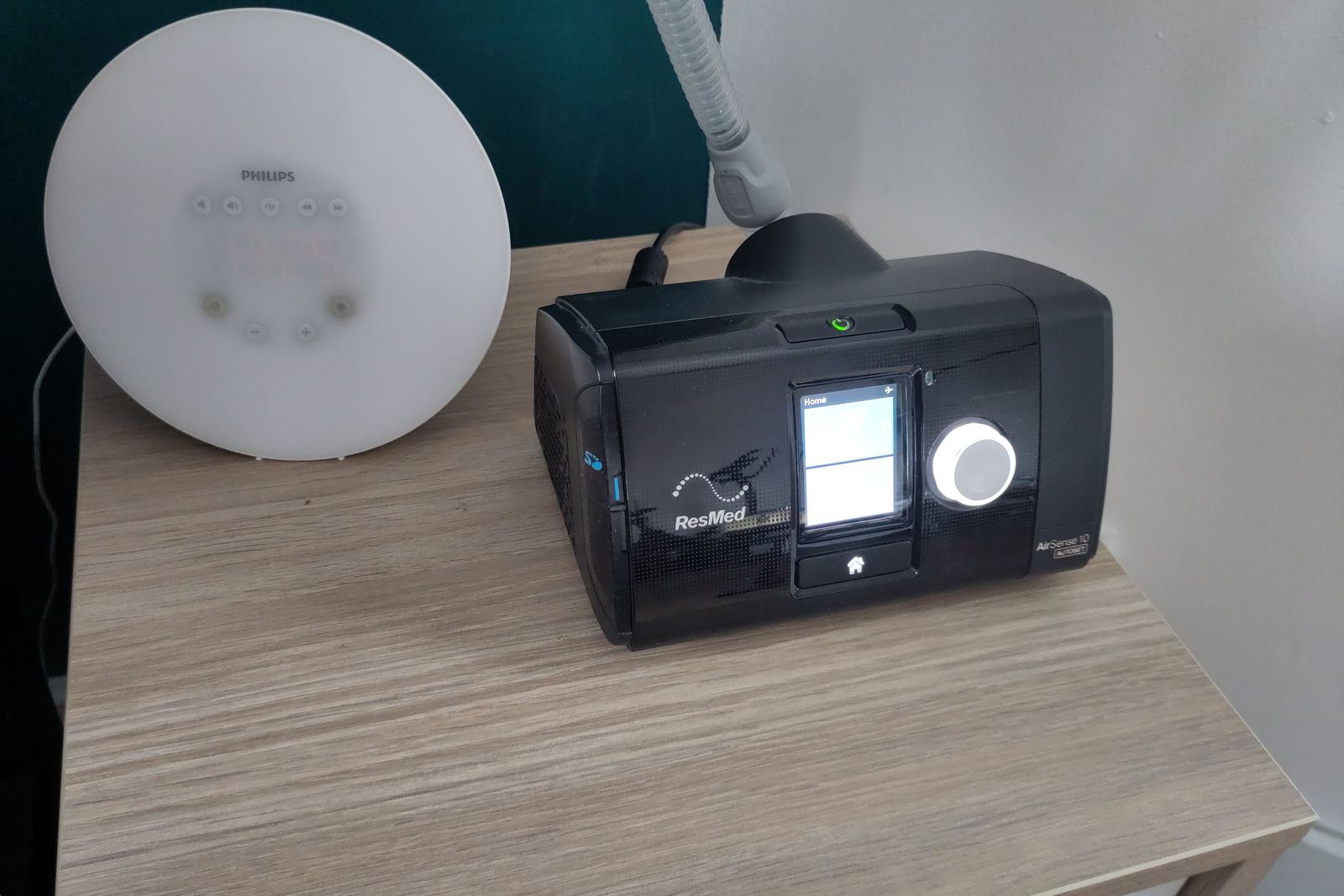
ResMed’s battery guide shows this clearly. It lists the current an AirSense 10 draws at 12 V through ResMed’s own DC converter, at pressures from 6 to 20 cm H2O. With standard tubing and no humidifier, the machine draws 0.70 A at 6 cm H2O and 1.66 A at 20 cm H2O. With the humidifier on setting 8, the same machine draws 3.44 A to 4.59 A.
Multiply amps by 12 V and you get watts. That puts the AirSense 10 at about 8 to 20 W with no humidifier and about 41 to 55 W with the humidifier on 8.
How much energy a CPAP uses in a night
To turn watts into watt hours, multiply by the hours you sleep. The table uses a pressure of 10 cm H2O, which sits in the middle of ResMed’s range, and an 8 hour night.
| AirSense 10 setup at 10 cm H2O | Current at 12 V | Average power | Energy for 8 hours |
|---|---|---|---|
| No humidifier | 0.93 A | About 11 W | About 89 Wh |
| Humidifier on setting 4 | 2.30 A | About 28 W | About 221 Wh |
| Humidifier on setting 8 | 3.66 A | About 44 W | About 351 Wh |
| Humidifier on 8 with heated tube at 30°C | 4.92 A | About 59 W | About 472 Wh |
Current figures are from ResMed’s battery guide. Power and energy are our arithmetic.
If your pressure is higher, your use will be higher too. At 20 cm H2O with the humidifier on 8, ResMed lists 4.59 A, which is about 55 W or 441 Wh a night.
Nights of runtime by power station size
A power station never delivers its full rated capacity. Some energy is lost as heat, and the battery management system holds a little back. Across WattFort we count 85 percent of the rated watt hours as usable, the same planning factor we use in our runtime calculator.
Using that factor and the 10 cm H2O figures above, here is roughly how many nights each size gives.
| Rated capacity | No humidifier | Humidifier on 4 | Humidifier on 8 | Humidifier on 8 with heated tube |
|---|---|---|---|---|
| 256 Wh | About 2.4 nights | About 1 night | Under 1 night | Under 1 night |
| 500 Wh | About 4.8 nights | About 1.9 nights | About 1.2 nights | Under 1 night |
| 1,000 Wh | About 9.5 nights | About 3.8 nights | About 2.4 nights | About 1.8 nights |
| 2,000 Wh | About 19 nights | About 7.7 nights | About 4.8 nights | About 3.6 nights |
These numbers assume the DC route at 12 V. If you plug the machine into the station’s AC outlet instead, the station’s inverter and the CPAP’s own power supply both waste some energy, so expect fewer nights. Inverter idle draw also eats into capacity if you leave AC switched on all day.
Treat the table as a starting point. ResMed’s guide itself builds a 50 percent safety margin into its battery sizes, because real nights vary with mask leaks, room temperature and how long you actually sleep.
Notes for popular machines
ResMed AirSense 10
The figures in the tables above come directly from ResMed’s testing of this model. ResMed sells a DC to DC converter for it, part number 37297, which lets the machine run from a 12 V or 24 V battery without going through an inverter.
ResMed AirSense 11
The AirSense 11 user guide lists a 65 W power supply, a typical power consumption of 56.1 W and a peak of 73.2 W. Those are ratings for the supply and the machine working hard, not an average over a night, so they are not directly comparable with the AirSense 10 table. Real use will depend on your pressure and humidifier settings.
ResMed’s Air11 DC/DC converter, part number 39231, accepts 12 V or 24 V input and works with the HumidAir humidifier and the ClimateLineAir heated tube. It plugs into a 12 V car style outlet, which most power stations have.
Philips DreamStation 2
The DreamStation 2 manual says the machine can run from a free standing 12 V battery using the Philips Respironics DC power cord and battery adapter cable, and that only Philips cords should be used. It also states that an 80 W power supply is required to support humidification. If the battery cannot support it, the machine shows a Humidifier Off alert and keeps running without warming the water.
DC adapter or AC outlet
There are two ways to connect a CPAP to a power station.
- Through the AC outlet. You plug the machine’s normal power brick into the station. This is the easiest option and needs no extra parts, but energy is lost twice, once in the station’s inverter and again in the CPAP supply.
- Through a DC converter or cord. You plug the maker’s DC accessory into the station’s 12 V car style socket. This skips the inverter, so more of the battery reaches the machine.
ResMed’s battery guide strongly recommends a DC converter over an inverter. It says converters are more efficient, protect against reversed leads, regulate voltage, shut down when the battery runs low and isolate the device. Where the guide discusses inverters for some of its other machines, it advises a pure sine wave model rated at 300 W continuous and 500 W surge with UL certification.
Most portable power stations today use pure sine wave inverters, but check the spec sheet before you buy. If you plan to use the DC route, also check that the station’s 12 V socket can supply the current your converter needs. The Air11 converter, for example, is rated for up to 10 A at 12 V.
What to do when the power goes out
ResMed’s guide to CPAP batteries explains that when the power fails your machine simply stops. Full face masks have an anti asphyxia valve, so you can still breathe room air, but treatment ends until power returns or you switch to a battery.
The machine cannot be plugged into the wall and a battery at the same time. That leaves you two choices.
- Switch over by hand. Keep the power station charged next to the bed, and when an outage wakes you, move the plug from the wall to the station.
- Run the CPAP through the station every night. Many power stations pass wall power through to the outlet and switch to battery when the grid fails. Switchover times vary by model, so check the spec sheet and test it by turning off the wall socket while the machine is running.
A simple routine before storm season helps.
- Charge the power station fully and top it up every few months.
- Keep the DC cord or converter in the same bag as the station.
- Do a full test night on battery so you know your real runtime.
- Note your pressure and humidifier settings, because the FDA advises checking settings after power returns.
- Keep a plan for longer outages, such as solar panels, a second battery or somewhere else to sleep.
Our power outage preparation checklist has a printable list covering medical devices alongside food, water and light.
Tell your utility and plan for longer outages
The FDA’s tips on medical devices during disasters advise letting your electric company and local fire department know that you rely on a medical device. It also suggests reading your device instructions or calling the maker about using batteries or a generator, and checking that the device is dry before plugging it back in after a flood.
If you use oxygen as well as a CPAP, read our oxygen concentrator backup power guide first. Many utilities keep a list of customers who rely on medical equipment. Being on it can bring outage warnings and priority contact, but it does not guarantee your power stays on, so you still need your own backup.
For outages that last days rather than hours, a single power station may not be enough. A larger expandable power station or a generator can keep you going. If you use a generator, the CPSC’s rule is to run it outdoors at least 20 feet from the house and never in a garage or near open windows. Our standby versus portable generator guide covers the safe options.
How to choose your power station
- Find your nightly watt hours. Use the table above or measure your own machine with a plug in meter for a full night.
- Decide how many nights you want. One night covers most short outages. Two or three nights gives peace of mind in storm areas.
- Divide by 0.85. That turns usable energy into the rated capacity to look for.
- Add the rest of your list. Phones, a router and a light add up fast, and a fridge changes the picture completely. Our buying guide for home backup power stations walks through a full day.
- Check the ports. Make sure there is a 12 V car style socket for a DC converter and a pure sine wave AC outlet as a backup. If you may need to recharge from a vehicle, read our guide to charging a power station from a car.
Renters and people in flats can find indoor safe options in our backup power guide for apartments and renters, and our guide on how long a power station lasts explains battery lifespan and charge cycles.
Staying warm on the same battery? A queen electric blanket uses roughly three times the power of a CPAP with its humidifier on. See how long a power station runs an electric blanket before you share one station between them.
Bottom line
For a CPAP, the humidifier sets the size of the power station you need. Without it, an AirSense 10 at a typical pressure uses about 90 Wh a night, so even a small station lasts several nights. With the humidifier and heated tube on, it can use about 470 Wh, so plan on 1,000 Wh or more for two nights. Use the maker’s DC converter where you can, test a full night before you need it, and tell your utility and fire department you rely on the machine.
This article is general information, not medical advice. Follow your CPAP maker’s instructions, and talk to your sleep clinician or equipment supplier before changing settings or relying on battery power.
Frequently asked questions
How many watts does a CPAP use?
It depends on the machine, the pressure and above all the humidifier. ResMed's battery guide measured an AirSense 10 at 12 V and found about 8 to 20 W with no humidifier across 6 to 20 cm H2O, and about 41 to 55 W with the humidifier on setting 8. The 65 W or 90 W printed on the power supply is a maximum rating, not what the machine uses all night.
What size power station do I need to run a CPAP for one night?
With the humidifier off, a station of about 256 Wh covers one night at typical pressures with room to spare. With the humidifier on a high setting, plan on at least 500 Wh for one night, and around 1,000 Wh if you also use a heated tube or want two nights. Add a second night of margin if the machine is essential.
Can I run my CPAP from a power station's AC outlet?
Usually yes, if the station has a pure sine wave inverter, but you lose some energy converting battery power to AC and back to DC. ResMed strongly recommends its DC converter instead because it is more efficient and protects the machine. Check your own manual and ask your equipment supplier before relying on either route.
Should I turn off the humidifier to make the battery last longer?
Turning it off cuts energy use by more than half in ResMed's figures, and some battery packs do not support humidification at all. Comfort and treatment can change without it though, so ask your sleep clinician or equipment supplier first rather than deciding during an outage.
What happens if the power goes out while I am using my CPAP?
ResMed says the machine simply turns off, and that full face masks have an anti asphyxia valve so you can still breathe room air. The machine cannot be plugged into the wall and a battery at once, so you have to move it to the battery yourself unless your power station passes power through and switches over on its own.
Thanks! You're on the list. Download your checklist now.